Have you ever picked up your phone from a charging pad first thing in the morning, only to find a cold, dead screen? If you bought into wireless charging five or six years ago, that scene probably feels painfully familiar. For years, charging without a cable was an overrated gimmick. You had to place your phone on a small plastic puck with surgical precision. If you were off by just a couple of millimeters, or if an incoming text made your phone vibrate, charging stopped completely. Worse yet, your device would cook itself overnight, leaving you with a lukewarm battery and an empty charge.
Times have changed. As we head into 2026, wireless charging has finally shed its awkward growing pains. What used to be a frustrating novelty is now one of the most reliable upgrades you can make to your daily routine.
The Evolution of Wireless Power From Gimmick to Necessity
The early days of the original Qi standard felt half-baked because the physics simply worked against us. Inductive charging works by transferring power between two copper coils. One coil sits inside the charger, and the other lives inside your phone. If those coils do not sit directly on top of each other, power transfer plummets.³
Back then, charging mats forced you into a guessing game. Misalignment caused charging efficiency to drop sharply, wasting up to 40% of the drawn electricity as raw heat.³ That excess heat did not just slow down the charge. It actively degraded your phone's lithium-ion battery over time.⁵
Today, the entire hardware experience is completely different. The industry moved away from finicky, flat mats and shifted toward integrated magnetic docks and multi-device stations. Hardware makers cracked the code on thermal management, coil design, and magnetic docking. The technology has evolved from a flashy tech demo into something you can actually rely on every single day.
Understanding the Convenience vs Speed Trade-offs
Let's address the elephant in the room: wired charging is still technically faster. If you plug a flagship phone into a 65W wall brick, you will always get a faster burst of juice than any standard wireless pad can supply.
So why bother switching? The answer comes down to convenience and habit.
Think of wireless power as the digital equivalent of an automatic garage door. Sure, lifting the garage door by hand only takes a few seconds, but once you get used to pushing a button, you never want to go back. Dropping your phone on a desk mount while you answer emails eliminates the constant cycle of fishing for stray cords behind furniture.
Modern wireless chargers also run much cooler than their predecessors.¹ By keeping charging frequencies steady and locking coils in place, newer hardware keeps efficiency between 75% and 85%.³ The temperature stays under control, so your phone does not aggressively throttle its charging speeds to protect itself. For an overnight bedside refill or a top-off during a workday, the minor speed difference compared to a cable barely matters.
The Game Changers Qi2 and MagSafe Standards
The real catalyst behind this shift is the arrival and rapid spread of Qi2 (pronounced "chee-two").
For a long time, Apple users had access to MagSafe, a system of built-in magnets that snapped accessories directly into the sweet spot. Meanwhile, everyone else was left dealing with slippery pads. Apple eventually contributed its magnetic patents to the Wireless Power Consortium. That move became the foundation of Qi2, creating an open standard that benefits the entire mobile ecosystem.¹⁰
Here is why this standard fixes nearly every historical headache
• Automatic magnetic lock: Strong ring magnets snap your phone into exact sub-millimeter alignment every single time.³ You get zero guesswork, zero alignment anxiety, and zero dead batteries in the morning.
• Universal fast charging: In the past, generic wireless pads locked iPhones to a sluggish 7.5W unless accessory makers paid for Apple's proprietary licensing.³ Qi2 opens up guaranteed 15W wireless power across certified devices, doubling those speeds without inflating prices.¹⁰
• Cross-platform harmony: Whether you carry an iPhone or an Android phone equipped with a magnetic case, a single magnetic charger works seamlessly across all your gear.
Newer flagship hardware has pushed wireless performance even higher, with select devices now supporting up to 25W wireless speeds. That is fast enough to deliver a 50% charge in roughly 30 minutes. The historic speed gap has narrowed to the point where most people will never notice it.
Choosing Your Setup: Charging Pads vs Stands
Ready to cut the cords? You will want to pick the right form factor for the spots where you spend the most time.
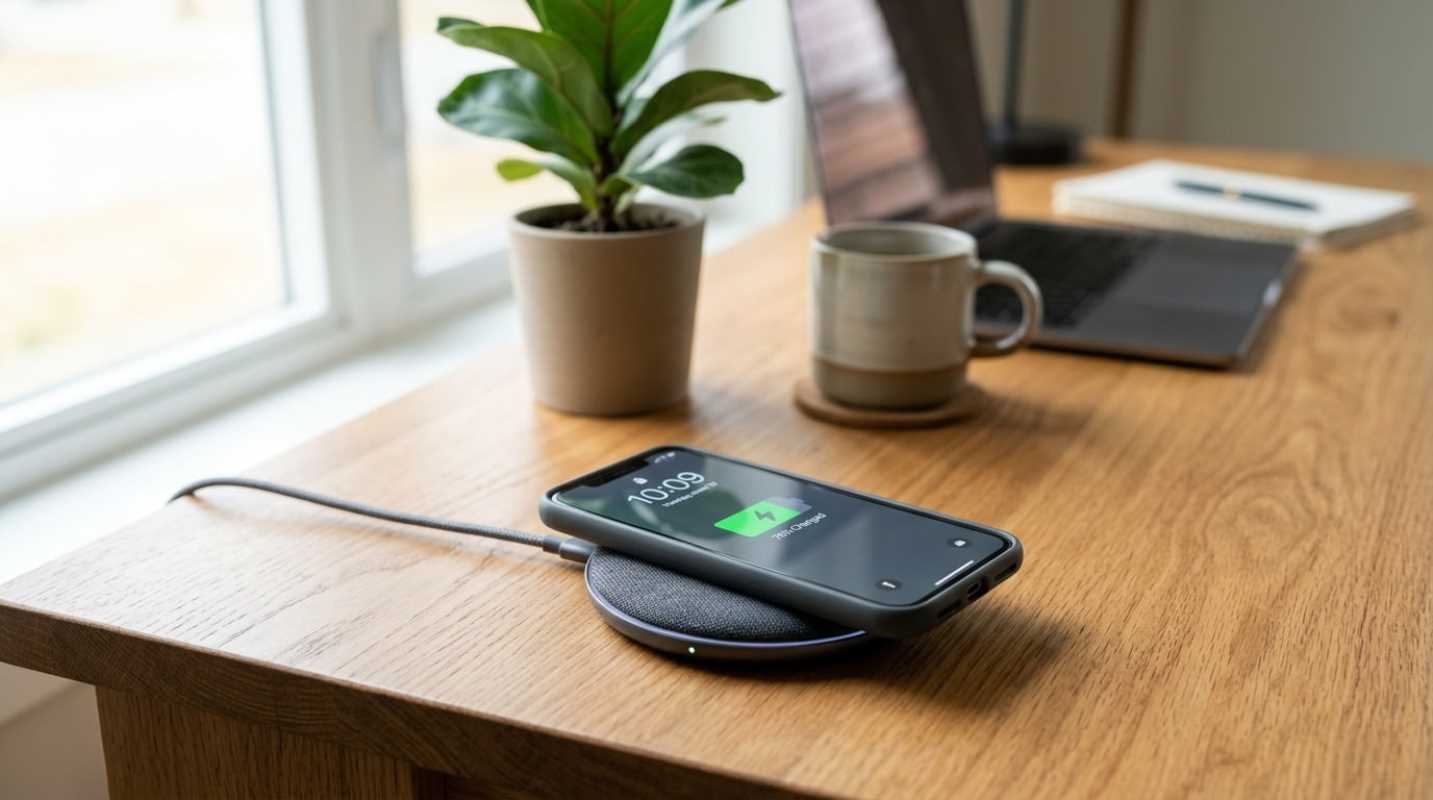
• Flat charging pads: These are ideal for bedside tables and quiet areas where you do not need to look at your display. They keep your nightstand minimal and work well as multi-device trays designed to power your phone, smartwatch, and wireless earbuds in one footprint.
• Upright magnetic stands: These belong on your work desk. An upright stand holds your screen at eye level, letting you unlock your phone with facial recognition or check timers without interrupting your work.
• Snap-on magnetic power banks: These eliminate the awkward mess of carrying a phone with a cord dangling into your pocket. The battery pack snaps directly to the back of the chassis and recharges your device while you walk around.
The Future of Cable-Free Living
Beyond the day-to-day convenience, making the jump to wireless power protects your devices in the long run.
Physical charging ports take an incredible beating. Between pocket lint gathering in the USB-C cavity and the physical wear of thousands of cable insertions, charging ports are often the first component to fail on an aging smartphone. Relying on magnetic induction saves that fragile port from daily abuse.
You do not need to replace every cord in your home overnight. But by adding a magnetic stand to your desk and a charging pad to your nightstand, you eliminate the constant clutter of frayed, tangled wires. Wireless charging has finally grown up, and there has never been a better time to make the switch.
Sources:
1. rorry.com
https://rorry.com/blogs/editors-picks/qi2-wireless-charging-magsafe-qi
2. akhxinpower.com
https://akhxinpower.com/qi-vs-qi2-wireless-charging-guide/
3. chargie.org
https://chargie.org/wireless-charging-battery-health-qi-damage/